
When in Italy, especially Florence, you will see lots of Renaissance frescoes. During the Medieval and Early Renaissance, most painting was either an altarpiece for a church or a fresco. Painting for private residences and oil painting came about a bit later in the Renaissance with artists like Botticelli, although fresco still held a prominent position — think the greatest fresco of all, the Sistine Chapel from the High Renaissance!
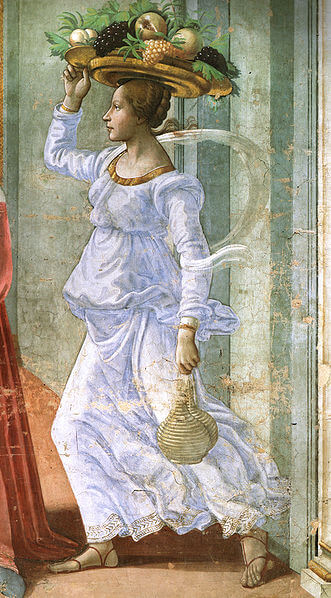
Frescoes are rarely chosen as people’s favorite type of art. They tend to be thought of as art that’s old, sometimes crumbling, maybe a bit boring. I might actually agree with that when it comes to some frescoes, but there are plenty of Renaissance frescoes in Florence that are sure to please. But why should frescoes get so much attention anyway?
The fresco technique is difficult. The artist applies plaster to a wall and paints the image on the plaster before it dries. This technique means that each time plaster is applied, the image must be finished that very day and makes it almost impossible for the artist to correct mistakes or make changes, as artists often do with other types of painting.
Fortunately, the fact that frescoes are part of the wall means that, in favorable climates, they last for a very long time. And because frescoes so often were used to decorate chapels and walls of churches, they were usually part of a cycle, meaning several frescoes that connected to tell a story.
Renaissance Frescoes in Florence (and late Medieval in Siena)
1) The Tornabuoni Chapel in Santa Maria Novella, Florence, 1485-1490
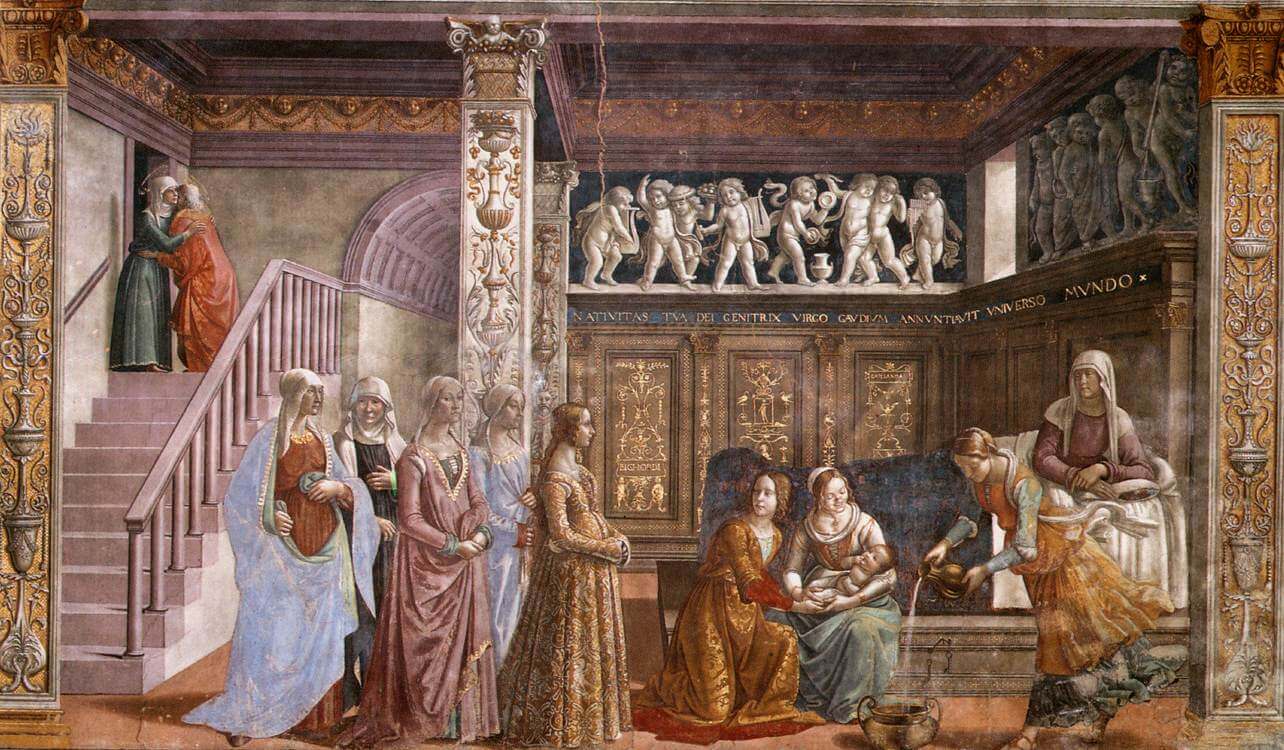
Santa Maria Novella has some of my favorite art in Florence. The main chapel houses the fresco cycle of the lives of Mary and St. John the Baptist. It is huge– the Renaissance master Domenico Ghirlandaio enlisted his workshop, including the 13-year-old Michelangelo, to help him complete the frescoes.
One reason to see this cycle of beautiful Renaissance frescoes is that it shows the trends of the Renaissance, from the beautiful details of the clothes and furniture to the hairstyles. Plus, it goes from floor to ceiling, enveloping you in its size, color, and detail. I love it.
Read more: Italy Travel Tips
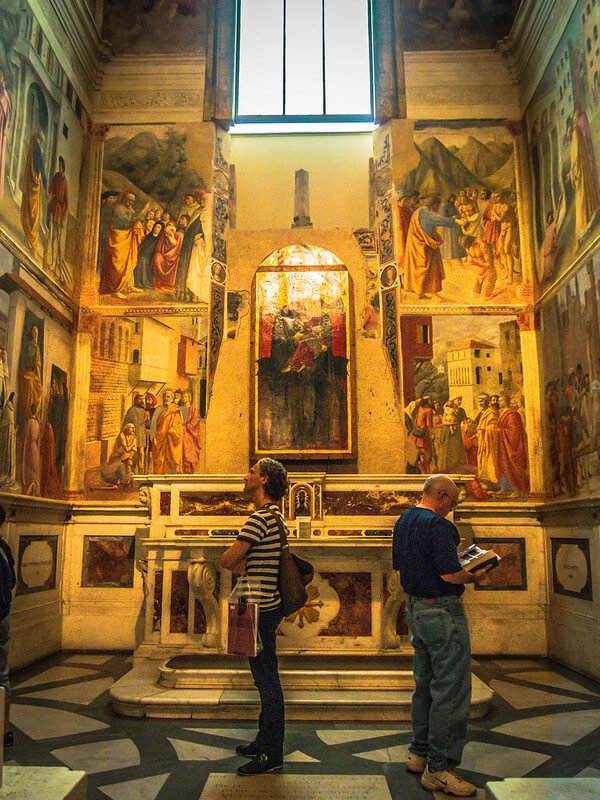
2) Fra Angelico’s early Renaissance frescoes in San Marco, Florence, 1436-1445
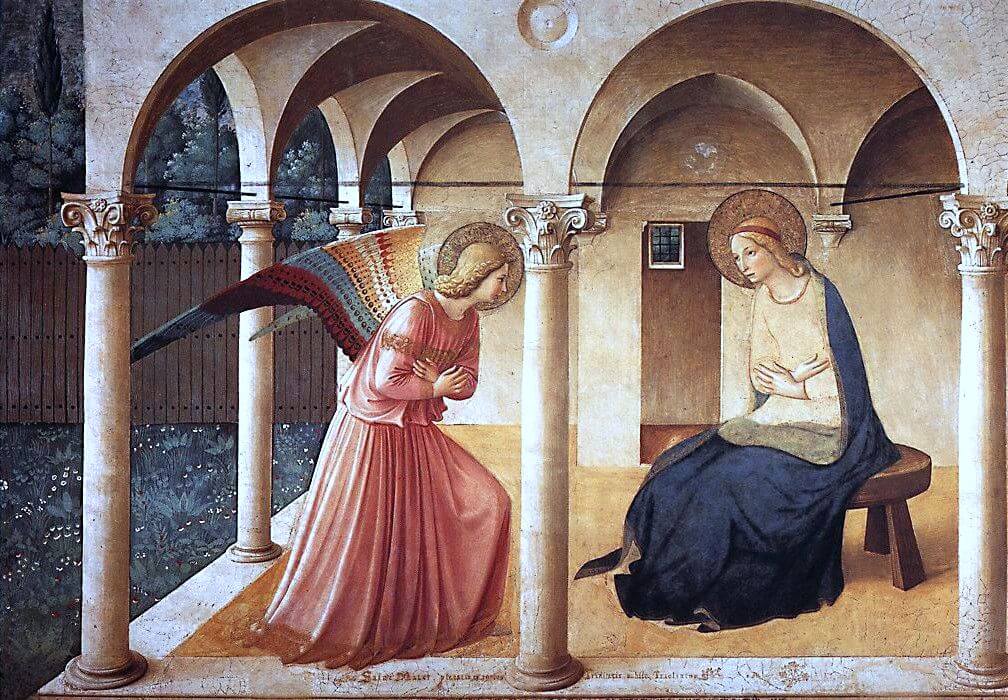
Not all Renaissance frescoes were enormous projects paid for by wealthy patrons seeking extra assurance of salvation. These small, simple frescoes were painted by Fra Angelico, a monk who took the innovations of the Early Renaissance to create his own delicate style. The simple religious scenes depicted in the frescoes decorated the monks’ cells for the purpose of contemplation and prayer.
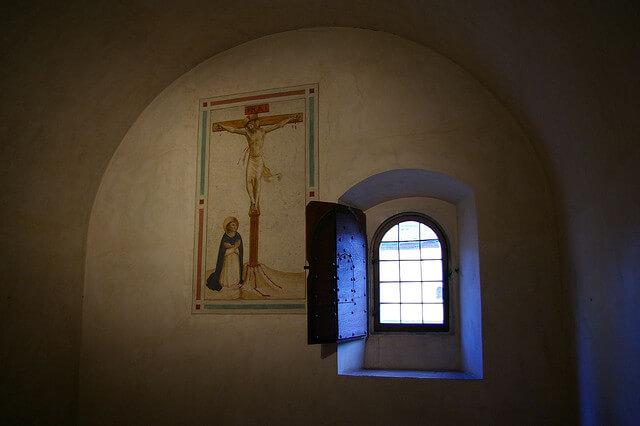
You can visit San Marco and see a perfectly preserved example of a convent from the 15th century Renaissance. Don’t miss the Crucifixion fresco in the Chapter House.
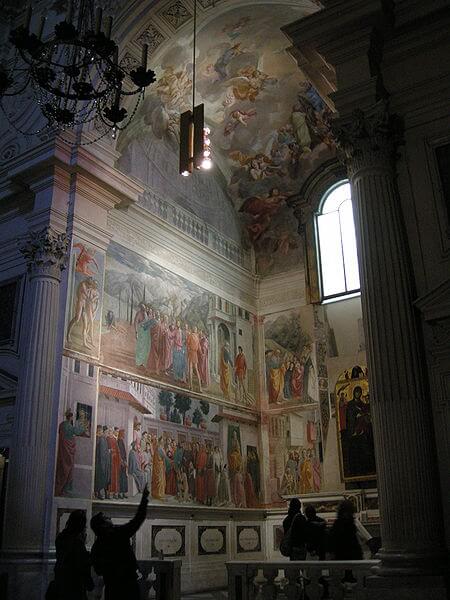
3) The Brancacci Chapel, Santa Maria del Carmine, Florence, (mostly) 1425-1427
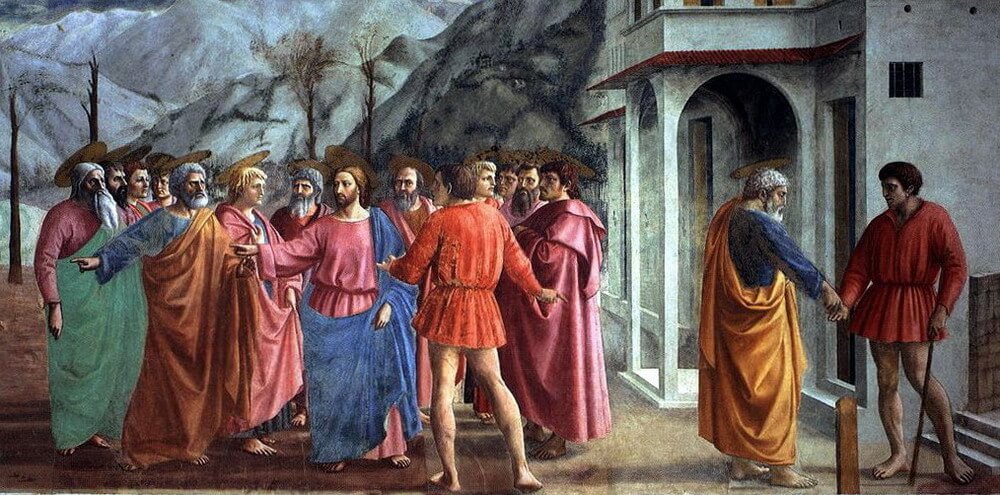
The Brancacci Chapel is probably the best place to see the artistic innovations of the Early Renaissance. Most of it was painted by the young artist Masaccio, whose ability to portray humans realistically helped bring the Renaissance ideals of humanism and creativity to life. This cycle of early Renaissance frescoes was so influential in the Renaissance that several decades after Masaccio painted it, Michelangelo came here to study fresco painting.
Read more: How to Spend 3 Days in Florence
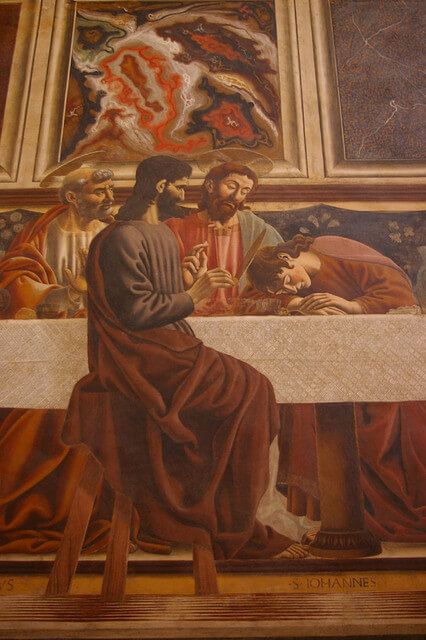
4) The Last Supper, Sant’Apollonia, Florence, c. 1445-1450
This fresco is off the beaten path in Florence. It’s located in the city center but in a former convent that is completely off the tourist radar. Go inside the convent’s refectory to experience this, and you will probably be there by yourself. The fresco is one of several notable last supper scenes painted during the Renaissance, but I like this one because it is unique.
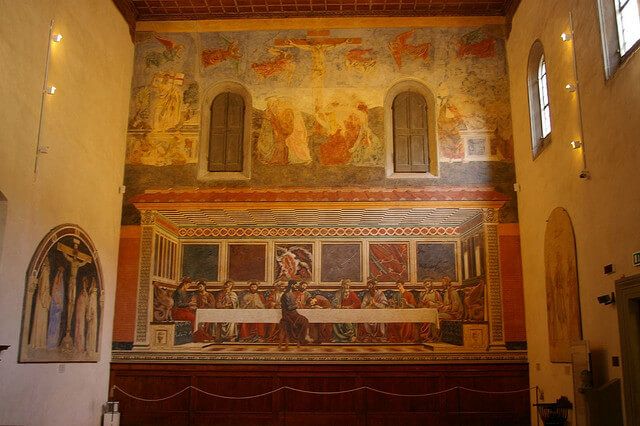
Andrea del Castagno was experimenting with the recent invention of linear perspective. The ceiling of the last supper scene leads your eye back in a dizzying geometric pattern.
The 6 panels above the men are unusual; notice that the most striking panel sits above the heads of Jesus and Judas. Judas’s face seems devil-like, and he is seated on the other side of the table, separated from the others, a sign of his eventual betrayal of Jesus.
5) The Allegory of Good and Bad Government, Palazzo Pubblico, Siena, 1340
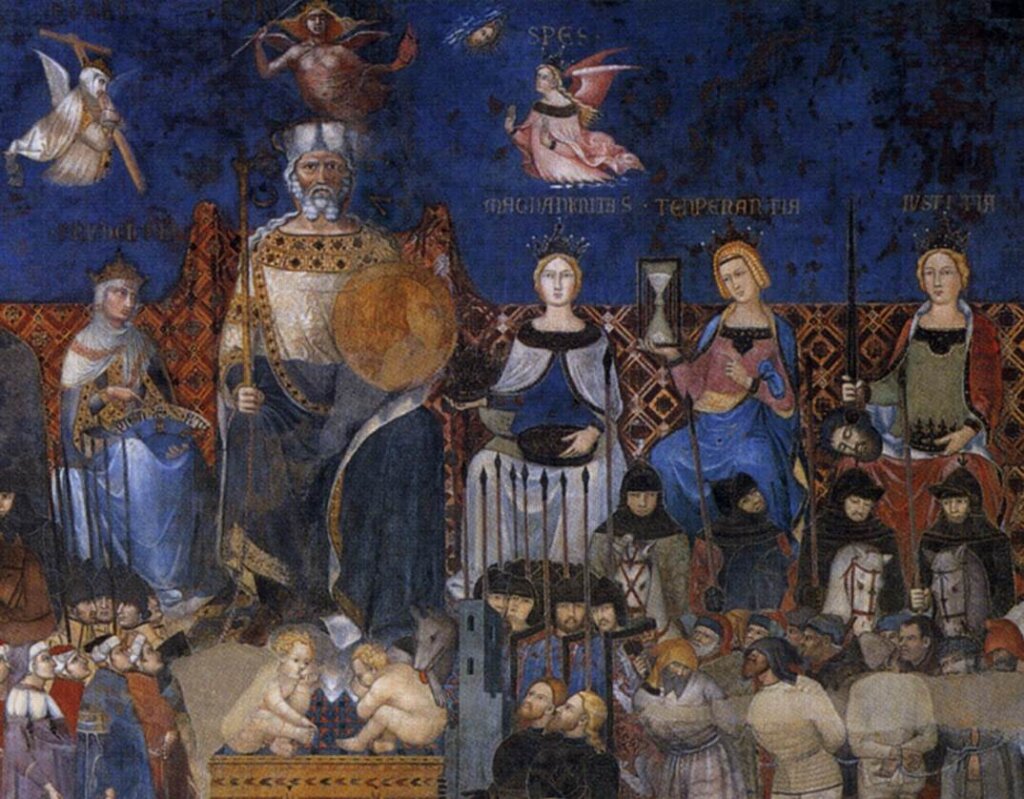
Go inside the beautiful Palazzo Pubblico on Siena’s main square to enjoy this wonderful late Medieval fresco. It wraps around the walls with bright colors and unusual details. It is quite different from other frescoes you will see because… it is not religious! Instead, the civic themes of good and bad government are shown since this is, after all, the town hall.
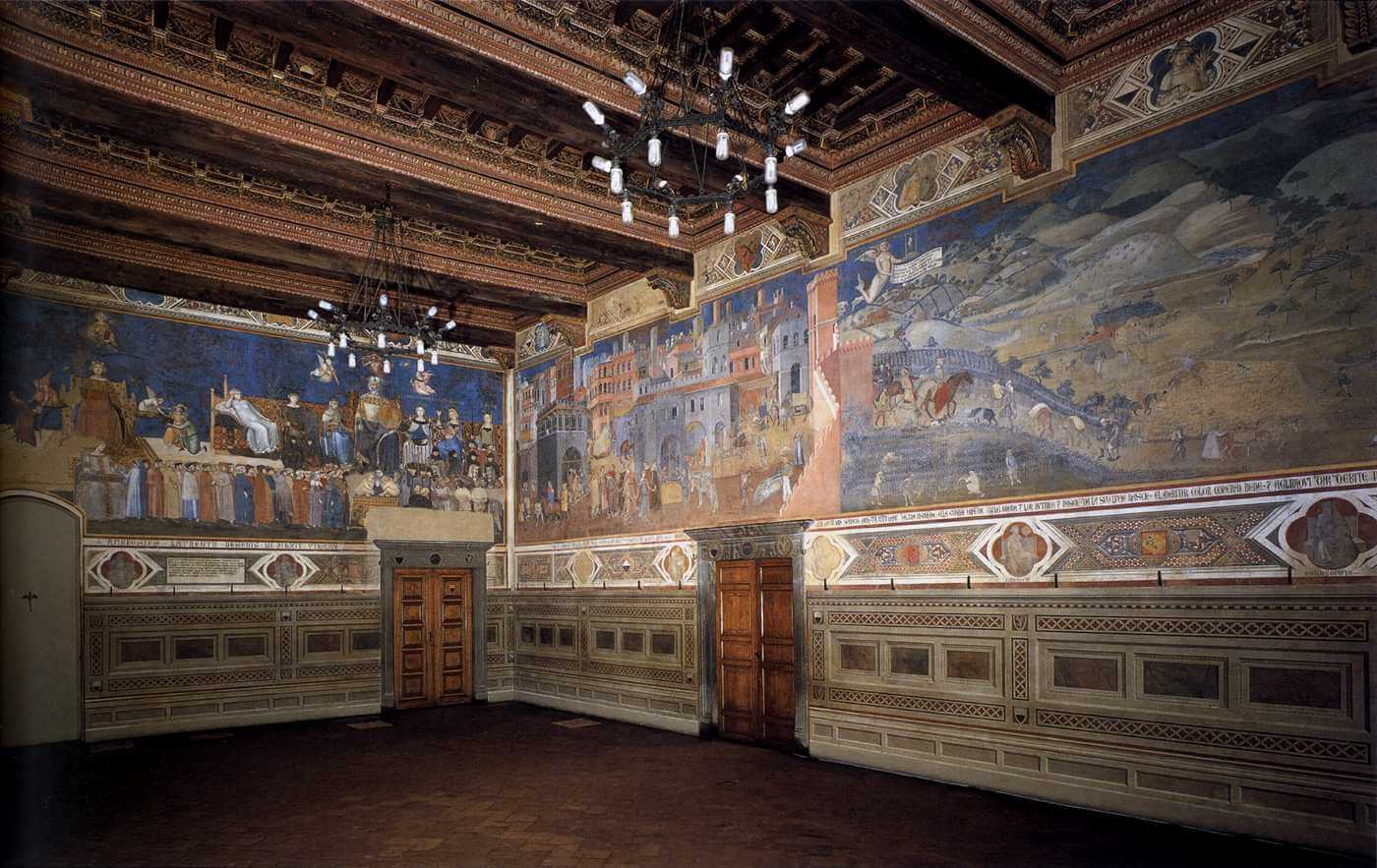
This fresco is from Siena’s heyday, in 1340 when it was a powerful city-state. Less than 10 years later, the plague hit Tuscany, and Siena lost up to half of its population. The city never recovered, so what you see now in Siena is a Medieval city with an unfinished cathedral and no Renaissance masterpieces. It is beautiful but had a very different fate from that of nearby Florence.
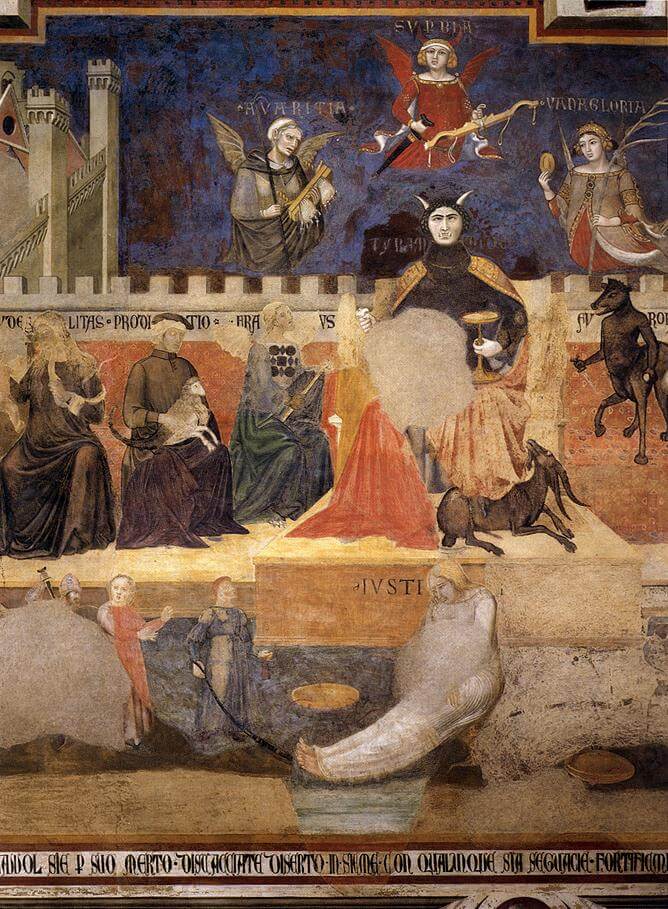
This fresco may have suffered some damage, but the weird details and intense colors are fantastic.
What are your favorite Renaissance frescoes in Italy?
(Photos are from Wikipedia Commons except the San Marco and Sant’Apollonia photos from dvdbramhall on Flickr)
More on art and life in Italy:
My Favorite Renaissance Paintings in the Uffizi
Tips to Understanding Renaissance Art
Two Words: strikingly beautiful.
I love this post! My favorite church for frescoes in Italy is in Verona. Chiesa Sant’Anastasia – just so many and so beautiful – I could just stare at the ceiling for hours.
Monique, Thanks for the tip! I know you used to live in Italy, so you must have seen A LOT of frescoes while you were there! I have not been to Verona. On the list 🙂
Jenna,
Wonderful post! The picture of San Marco I believe is stunning, very nice. I guess frescoes could be a way of life, there are beautiful ones out there. We went to Rome in Italy and of course watched frescoes in St.Peter Chathedral. I am sure that next time I will look at them with a different eye.
Yes, the frescoes in Rome are something, and I’m sure when you go to Italy again, you will see many more!
Beautiful, Jenna! I love frescos, they so often tell such interesting stories. Many villages and small towns in the Alps have the most wonderful old frescoes outdoors.
I hadn’t thought about frescoes in the Alps. I will have to see those for myself someday. And I agree– frescoes do indeed tell great stories.
These frescoes are amazing. And to think that the technique is so difficult, too. So many art treasures in Florence — hope to visit there sometimes and see for myself.
When you go, I will live vicariously through you 🙂
The Siena fresco and the Fra Angelico are probably my favorite two of the ones you featured. I can never get enough secular scenes from the late Middle Ages. The details and actions depicted are always entertaining. Like the marginalia in illuminated manuscripts. And the Fra Angelico one is just stunning in its simplicity.
I completely agree!
very interesting! I’d love to visit Florence
I was fascinated by the fact that the artist paints directly on the wet plaster and can’t really fix mistakes! Are there any famous mistakes that have been preserved that I should look for if I’m ever lucky enough to make it to Italy?
hi,
I really enjoyed your post, as it showed me some frescos I hadn’t seen yet.
In case you ever come to England, you might enjoy two frescos I created in the town of Bedford.
I learned to make frescos in 2012, and developed my own lime plaster which withstands freezing winters and summer heat, so that I could create these works outdoors for people to enjoy for free.
Each is about 400 square feet; one is Michelangelo’s Libyan Sibyl, the other is AJ Casson’s White Village. I am now working on a Degas of ballet dancers, to develop a looser, more dreamlike style.
Thanks again for your very thoughtful and beautifully illustrated post.
Thanks for sharing!